
AI for Small Business: Where to Actually Start (Without Wasting Time or Money)
Everyone is telling business owners to “use AI.” Almost nobody is telling them where to start.
If you run a growing company, you have probably felt this already. Maybe someone on your team tried ChatGPT for a few emails. Maybe you signed up for a tool or two. And maybe, a few months later, nothing has really changed about how work gets done.
That is not a failure of AI. It is a starting-point problem. AI creates value when it is pointed at a specific, recurring piece of friction in your business, not when it is adopted for its own sake.
In this guide, we will cover:
- Why so many businesses struggle to get value from AI
- Where AI can realistically help a small or mid-sized business
- A simple process for finding and ranking your best opportunities
- What to skip, and when to do it yourself versus getting help
Why Is It So Hard for Small and Mid-Sized Businesses to Start With AI?
Most businesses struggle with AI because they start with tools instead of problems. Without a clear picture of where time is actually lost, AI experiments stay scattered and never become part of daily work.
A few patterns show up again and again:
- Tool-first thinking. A new app gets tried because it is popular, not because it fits a known bottleneck.
- No owner, no follow-through. One person experiments, but nobody is responsible for turning a good result into a repeatable process.
- Too many subscriptions. Each tool solves a sliver of a problem, and the stack gets harder to manage.
- Unclear expectations. Without a defined “before and after,” nobody can tell whether the effort paid off.
The fix is not more tools. It is a clearer starting point.
Where Can AI Realistically Help a Mid-Sized Business?
AI tends to help most with repetitive, information-heavy work: re-entering data, answering the same questions, and turning raw notes into usable documents. These tasks eat hours every week, and they rarely need a person’s judgment at every step.
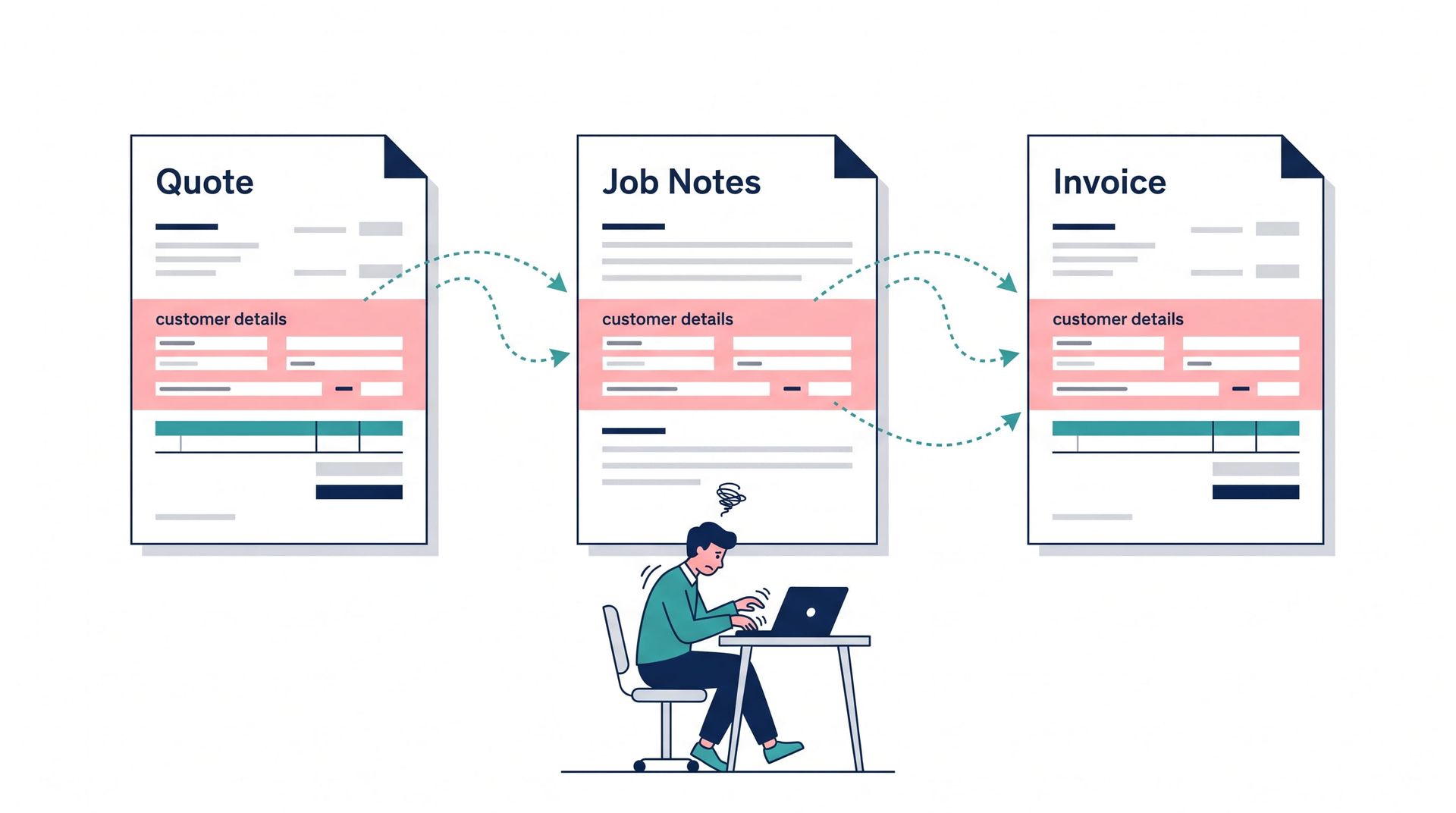
The Same Data, Typed Three Times

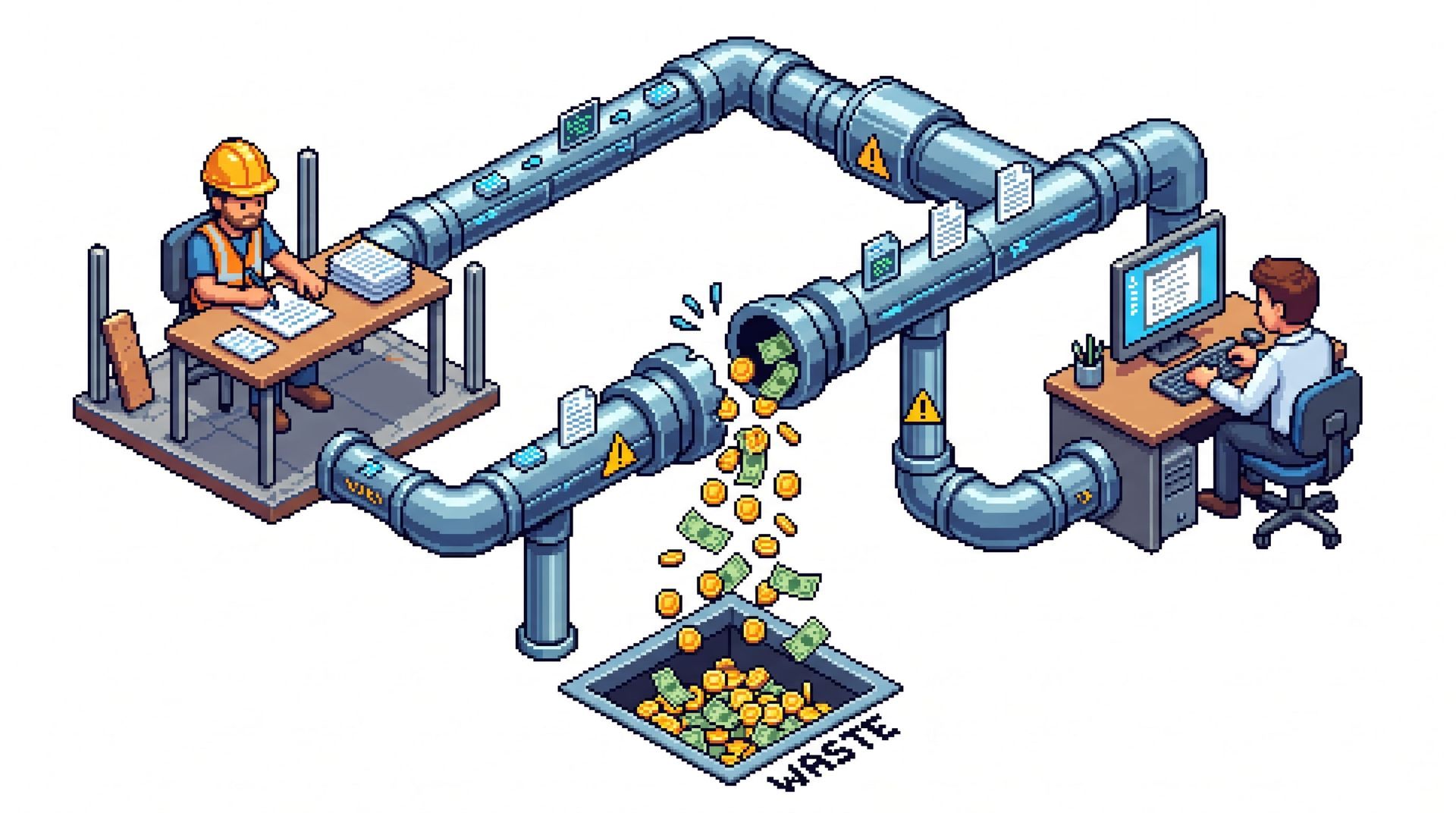
In many companies, a single job touches a quote, a set of job notes, an invoice, and a spreadsheet. Each one often needs the same customer, scope, and pricing details, entered by hand.
AI and automation can help by pulling information from one place into the next, flagging mismatches, or drafting documents from data you already have. The goal is simple: enter it once, use it everywhere.
Inboxes Full of Repeat Questions
Status checks. Scheduling back-and-forth. “Where is that file?”
These questions are reasonable, but answering them one by one takes real time. AI can help draft responses, summarize long threads, or point people to the right information faster. That frees your team for work that actually needs them.
Turning Notes Into Usable Documents
Field notes, meeting notes, and inspection observations often need to become something more polished before they reach a customer or manager. AI is well suited to drafting summaries, reports, and follow-up emails from rough input, with a person reviewing the final version.
How Do You Find the Right AI Opportunities in Your Business?
Start by mapping how work actually flows today, then rank the friction points by effort and impact. The best first AI project is usually small, frequent, and easy to measure.
Here is a practical five-step approach:
- Map your tools and workflows.
List the software, spreadsheets, and handoffs your team relies on. Note where information moves from one person or system to another.
- List the repetitive tasks. Look for work that happens daily or weekly and follows a predictable pattern.
- Estimate the time cost. Ask the people doing the work how long each task takes. Rough numbers are fine.
- Rank by effort and impact.
Sort each opportunity by how hard it would be to improve and how much time or frustration it would remove.
- Pick one quick win and measure it. Try one improvement, check the result after a few weeks, and refine it before expanding.
This follows the Plan-Do-Study-Act (PDSA) cycle that guides how we approach every improvement project: plan the change, try it, study the result, and act on what you learned.
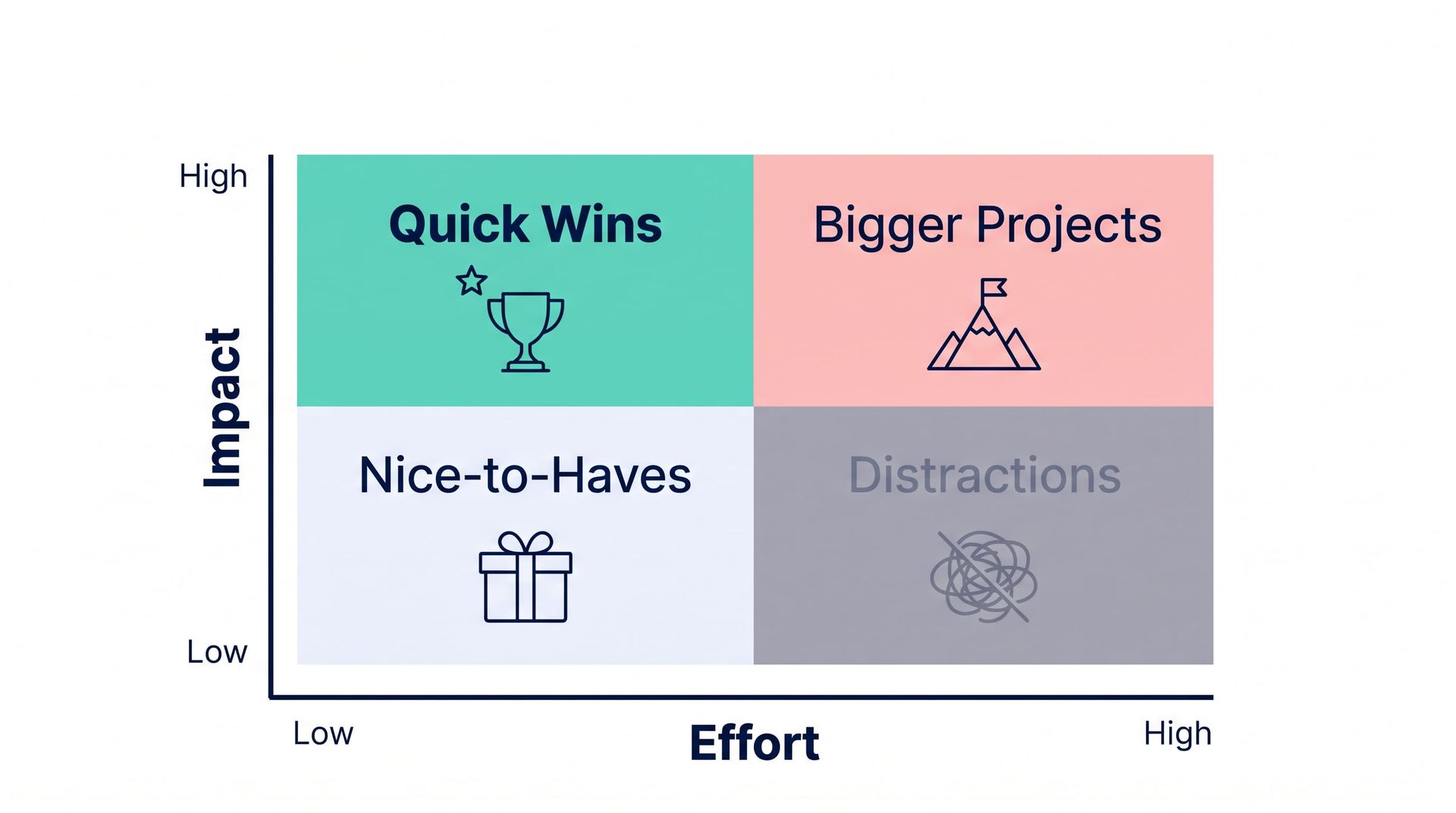
A Simple Effort-vs-Impact Filter

When you rank opportunities, four groups usually appear:
- Quick wins (low effort, high impact): Start here.
- Bigger projects (high effort, high impact): Plan these once quick wins prove the approach.
- Nice-to-haves (low effort, low impact): Do them if they are free and easy.
- Distractions (high effort, low impact): Skip these.
What Should You Skip When Getting Started With AI?
Skip anything that automates a broken process, adds another disconnected tool, or has no clear owner. AI makes a good process faster, but it also makes a bad process fail faster.
Common things worth avoiding early on:
- Automating a workflow nobody agrees on. Fix the process first, then add technology.
- Buying a tool before defining the problem. A subscription is not a strategy.
- Building complex custom AI before testing a simple version. Prove the value with a small step first.
- DIY apps without a maintenance plan. Building a quick tool with AI can feel like a shortcut, but
someone still has to support, secure, and update it.
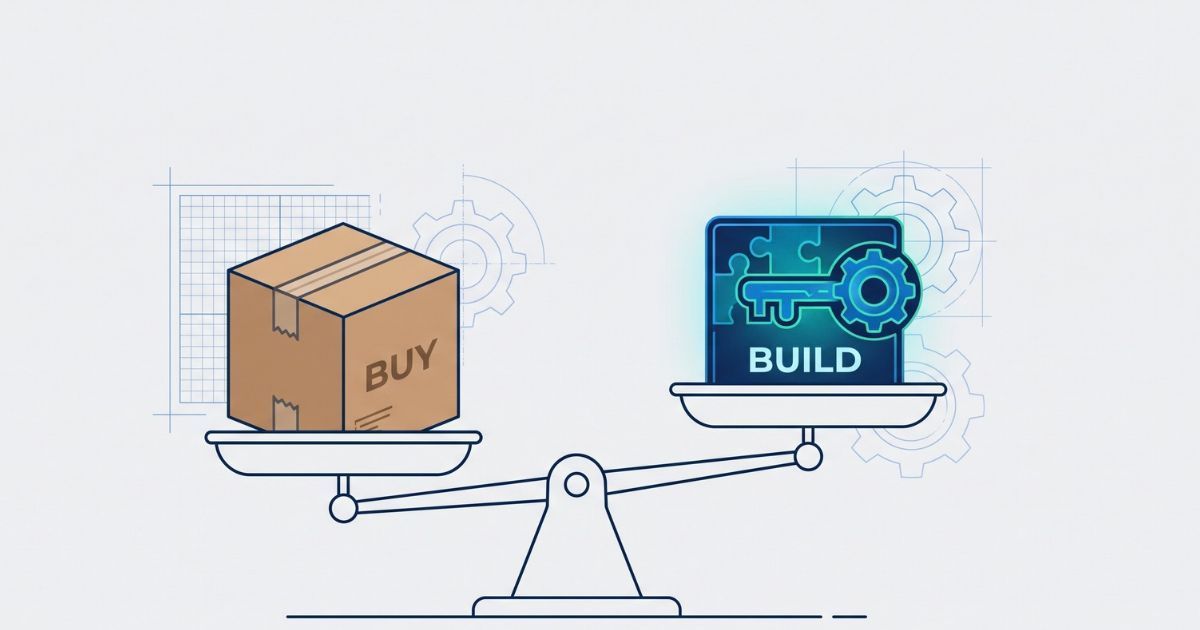
Should You Do It Yourself, Buy a Tool, or Build Something Custom?
The right answer depends on the problem: many AI wins are things your team can do on its own, some are best solved with an existing tool, and a few justify building something custom. A good plan sorts your opportunities into those three buckets.
- Do it yourself when the task is simple and low-risk, like drafting emails or summarizing notes with a general AI assistant.
- Buy a tool when a proven product already fits your workflow without forcing your team to change how it works.
- Build something when the opportunity is valuable, specific to how your business runs, and needs to connect with the systems you already use.
For teams that want to build their own tools, platforms like Lovable can get an idea off the ground quickly.
Modern Mindset is a certified Lovable Expert Partner, and we help businesses take those apps from prototype to a supported, production-ready product.
What Does an AI Consultation With Modern Mindset Look Like?

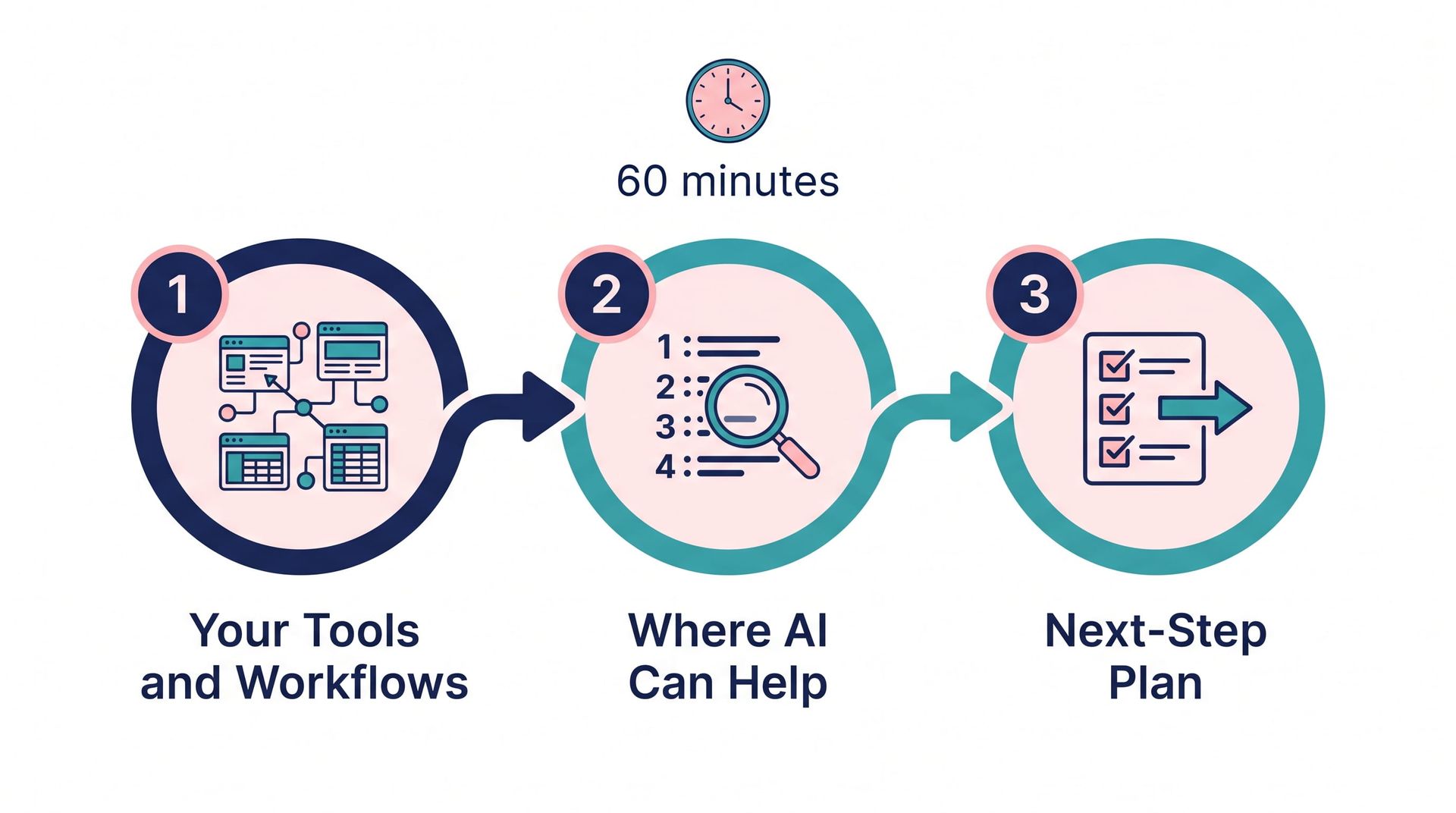
Our AI consultation is a focused one-hour working session that identifies where AI can save your team real time, then gives you a practical plan for what to do next. It starts from how your business works today, not from a list of tools.
The session covers three things:
- Your tools and workflows. We walk through the software, spreadsheets, and handoffs your team relies on.
- Where AI can realistically help. You get concrete opportunities ranked by effort and impact, including quick wins you can start right away.
- A practical next-step plan. What to do yourself, what is worth building, and what to skip.
What to know before you book:
- Virtual: $250 for the first hour, held on Google Meet.
- Onsite: $450 ($250 plus $200 travel) at your office in Connecticut or western Massachusetts.
- Prep summary: After you book and share a little about your business, you receive a personalized prep summary within minutes.
- Implementation: If you decide to move forward, implementation is scoped after the consultation, and your consultation fee is credited toward the project.
Start Small, Start Specific
AI does not have to be overwhelming. The businesses that get real value from it follow the same pattern:
- They start with a specific problem, not a tool.
- They map their workflows before changing them.
- They rank opportunities by effort and impact.
- They prove one quick win before expanding.
You do not need an AI strategy for every department. You need one clear starting point that saves your team real time.
Ready to find yours?
Book a one-hour AI consultation with Modern Mindset, and leave with a practical plan built around how your business actually works. Not ready to talk yet?
Download our free AI Starter Kit and AI Readiness Checklist
to start mapping your opportunities today.
Frequently Asked Questions
Where should a small business start with AI?
Start with one repetitive, time-consuming task, not with a tool. Map how work moves through your business, find where people re-enter data or answer the same questions, and test AI on the highest-impact, lowest-effort task first.
What are the best AI use cases for small and mid-sized businesses?
The most practical use cases are reducing duplicate data entry, handling repeat questions like status checks and scheduling, and turning rough notes into polished documents. These tasks happen often, follow predictable patterns, and free up real staff time when improved.
Why do AI tools fail to stick in many businesses?
AI tools usually fail when they are adopted without a defined problem, a clear owner, or a way to measure results. Starting with a specific workflow and a simple before-and-after measure makes adoption far more likely.
How much does an AI consultation cost with Modern Mindset?
A virtual AI consultation with Modern Mindset costs $250 for the first hour. Onsite sessions in Connecticut and western Massachusetts cost $450, which includes $200 for travel, and the consultation fee is credited toward any implementation project.
Should a business build custom AI tools or use off-the-shelf software?
It depends on the problem. Use off-the-shelf tools when they fit your workflow as-is, and consider building custom when the opportunity is valuable, specific to how your business runs, and needs to connect with your existing systems.
Find your first AI quick win.
One hour. Your tools and workflows. A practical plan for what to do next.