

2016 vs 2026: How Field Service Operations Evolved Into Real-Time Systems

June 30, 2026

Share this article

Field service work has always been about coordination.


People, schedules, materials, and timing all need to align for work to move forward. For a long time, that coordination relied on a combination of spreadsheets, phone calls, paper forms, and shared understanding inside teams.


This approach developed gradually. It wasn’t designed in one moment—it formed over years as businesses grew and adapted to increasing complexity.


Over the last decade, however, the way that coordination happens has shifted. By 2026, many field service organizations now operate with connected systems that bring together field activity, office workflows, and business data in real time.


The change is not only about technology. It reflects a different way of organizing information and decision-making inside a company.

How Field Service Work Commonly Operated in 2016

In 2016, most field service processes were built around sequential communication.


A job would typically begin with a request that was recorded in a spreadsheet, a whiteboard, or a basic scheduling tool. From there, details were passed to field teams through phone calls or messages.


Once on site, technicians documented their work using paper forms or handwritten notes. These were returned to the office later, where they were manually entered into another system for recordkeeping, billing, or reporting.


Information moved in steps, rather than continuously. Each step depended on someone passing it forward.


This structure worked well enough for smaller operations. As organizations expanded, the time between each step became more noticeable, and coordination required more effort to maintain.

Hands analyzing charts and graphs beside a laptop on a desk

Where Coordination Began to Strain

As the volume of work increased, the gaps between steps became more visible.


Information often arrived after decisions had already been made. Teams in the field and office sometimes worked from slightly different versions of the same job details. Tracking progress required checking multiple sources or contacting people directly.


Over time, a significant portion of operational effort shifted toward maintaining alignment—making sure everyone understood what was happening at any given moment.


This added a layer of work that did not directly contribute to completing jobs, but was necessary to keep the system functioning.

How Field Service Operations Function in 2026

By 2026, many organizations have moved toward systems where information flows continuously rather than in stages.


Jobs are created in centralized platforms that also handle scheduling, documentation, and reporting. Field teams receive structured job information directly on mobile devices. As work is completed, data is recorded in a consistent format and updated immediately across the system.


Billing, reporting, and operational tracking are connected to the same underlying data.


Instead of information being passed between separate tools or people, it is captured once and made available wherever it is needed.

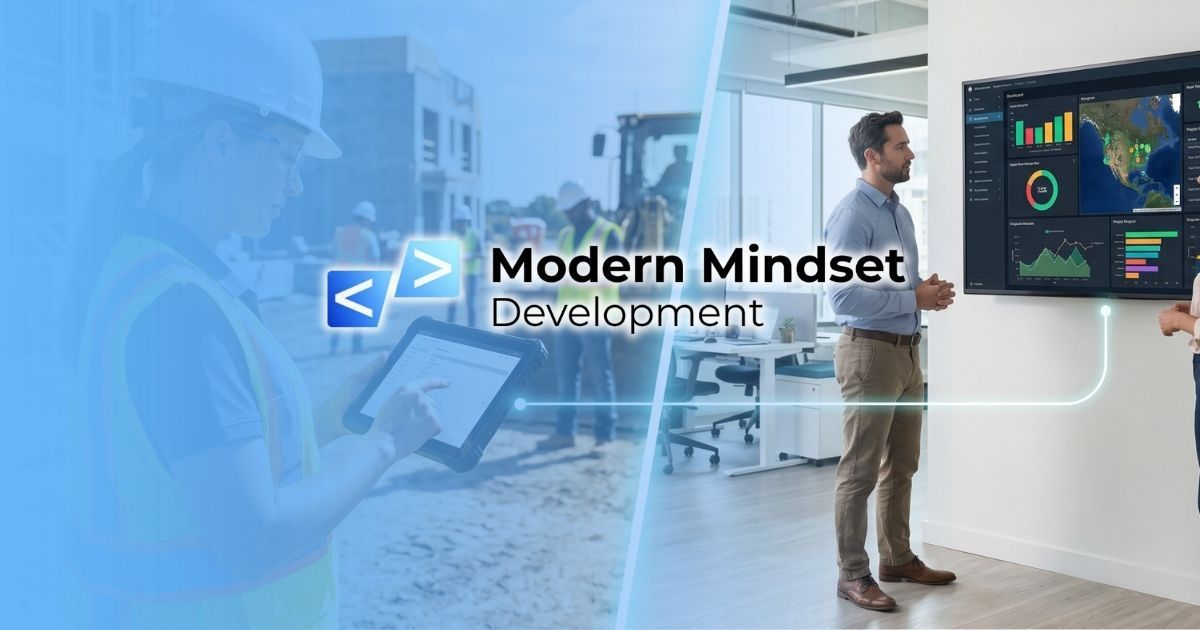
Three people reviewing design layouts in an office, with a laptop and monitor displaying charts and graphics.

A Typical Modern Field Workflow

A modern field service workflow often follows a continuous sequence:


  1. A job is created in a central system
  2. The job is assigned based on availability and requirements
  3. Field teams receive structured job details on mobile devices
  4. Work is documented in real time using standardized forms
  5. Updates sync automatically to office systems
  6. Job status becomes visible across teams immediately
  7. Billing processes are initiated based on completed work
  8. Leadership views operational progress through dashboards


The key difference is that information does not need to be reconstructed after the fact. It is recorded as part of the work itself.

What Changes When Information Becomes Real-Time

When operational data is consistently available, several patterns begin to shift.


Teams spend less time checking status and more time acting on it. Communication becomes more targeted because context is already available. Administrative work decreases because data does not need to be re-entered or reconciled.


Decision-making also changes in subtle ways. Instead of relying on periodic summaries, leaders can observe ongoing activity and respond as conditions evolve.


The effect is less about speed and more about continuity of understanding across the organization.

How Organizations Typically Move Between These Models

The transition from fragmented systems to integrated workflows tends to follow a gradual path.


It often begins with mapping how work actually moves through the organization—where information is created, how it is shared, and where it is lost or delayed.


From there, companies usually focus on improving the consistency of data capture in the field. Once that foundation is in place, systems begin to connect: scheduling, reporting, billing, and customer communication gradually move into a shared structure.


Over time, this creates a feedback loop where operational data not only reflects work but also improves how work is planned and executed.


This approach aligns closely with continuous improvement methods such as PDSA (Plan–Do–Study–Act), where systems evolve through iteration rather than replacement.

When Custom Systems Become Relevant

Many organizations begin with standard software tools, which are often sufficient for early stages of growth.


As operations become more complex, challenges can emerge when tools begin to overlap or when workflows do not fit neatly into predefined structures.


In these situations, the question is less about replacing software and more about aligning systems with how work is actually performed.


Custom-built systems are often introduced when that alignment becomes difficult to achieve with off-the-shelf tools alone.

What “Modern Operations” Represents

Modern field service operations are defined less by specific tools and more by how information is handled.


Common characteristics include:


  • Work activity visible in real time


  • Data captured once at the source of work


  • Reduced reliance on manual coordination


  • Consistent structure across teams and departments


  • Ongoing refinement of processes based on actual usage


This creates an environment where operations are easier to understand while they are happening, not only after they are reviewed.

Closing Perspective

The shift from 2016 to 2026 field service operations reflects a broader change in how organizations manage complexity.


As work becomes more interconnected, the value of consistent, real-time information increases. Systems that support this flow reduce the need for constant coordination and allow teams to focus more directly on execution.


Modern Mindset Development works with organizations navigating this transition by designing systems that reflect how work actually happens, rather than how it was originally documented.


The goal is not to add more tools, but to create a structure where the work itself becomes easier to understand, manage, and improve over time.

Frequently Asked Questions

  • What changed most in field service operations since 2016?

    The biggest change is how information moves. In 2016, job updates relied on phone calls, spreadsheets, and paper forms. In 2026, most field service operations use connected systems where updates are captured in real time and shared instantly across teams. This reduces delays, improves accuracy, and gives leadership immediate visibility into ongoing work.

  • Why do companies move away from spreadsheets and manual tracking?

    Spreadsheets and manual systems tend to work well at small scale, but they become difficult to manage as operations grow. Information gets duplicated, updates become inconsistent, and teams spend more time coordinating than executing. As complexity increases, businesses often shift toward structured systems that centralize data and reduce manual coordination.

  • Do all field service companies need custom software to modernize?

    Not always. Many companies can improve operations using existing tools if their workflows are relatively simple. However, when processes become more complex or require multiple disconnected systems to work together, custom software can help align operations with how the business actually functions. The focus is less on software itself and more on reducing friction in how work is managed.

Close the gap from the field to the front desk.

Real-time reports. Zero double-entry. One platform. It’s time for a system that’s as mobile as your crew.

Recent Posts

Modern Mindset Excellence banner with blue tech-themed office scene and man viewing a monitor
June 19, 2026
Disconnected office and field teams cause delayed billing, rework, and blind spots. Learn how to fix broken workflows and build a connected operation.
Modern Mindset presentation with three people in safety gear at a whiteboard
June 11, 2026
Adding apps won't fix broken operations. Learn how to identify workflow bottlenecks, improve field-to-office communication, and scale your business.
Blue promo graphic with “Modern Mindset” text and a black device printing white shredded paper
May 15, 2026
Lift Office transforms crane project management. Ditch paper tickets, digitally dispatch resources, and invoice minutes after a job is complete.
Modern Mindset Development displayed on a desktop monitor in a blue-toned workspace
May 8, 2026
Discover how custom software solutions from Modern Mindset consolidate subscriptions, automate daily tasks, and eliminate unprofitable gray work to boost ROI.
Text reading:  “Where your business is losing money in 2026” by Modern Mindset Development
April 17, 2026
Where your business is losing money in 2026—from manual work to disconnected systems—and how fixing the right processes can help you regain revenue.
Announcement graphic: Modern Mindset Development partners with ASL Education Center.
April 7, 2026
Modern Mindset Development partners with ASL Education Center to build custom software and tools that enhance ASL assessment, testing, and accessibility for schools and organizations.
A person wearing a yellow hard hat and orange safety vest stands at a construction site, looking toward a crane.
March 27, 2026
Discover where construction workflows break. Learn how hidden gaps between field, office, and systems slow operations and delay revenue.
An aerial view of a busy construction site with cranes and buildings under construction, topped by the title text.
March 23, 2026
Off-the-shelf software often fails growing construction companies by creating workflow gaps, poor field-to-office communication, and costly inefficiencies. Learn why—and what to do instead.
Image of Lift Office logo
March 6, 2026
Learn what Lift Office is and how it helps crane & rigging companies streamline operations, manage jobs, improve field reporting, and simplify quoting and invoicing.
Maneessha Bommineni welcome post graphic for Modern Mindset Development
February 25, 2026
Meet Maneessha, a software developer joining Modern Mindset with expertise in Java, Spring Boot, ReactJS, and AWS, driven by growth and innovation.
Show More